Hi, I am Carolien and I am a Dutch woman trying to build a self sufficient homestead on concrete and rubble.
Follow my husband and me on YouTube: https://www.youtube.com/@straverhomestead9667
I sowed green beans in weeds. Did I have anything to harvest?
Well yes, I was able to pick a few green beans here and there, but the green beans generally weren’t much of a success this year. Here is the link to my first post.
I can not really draw any conclusions out of my experiment, since the weeds did not do well either. The green beans I had sown in the greenhouse and later planted in the garden did a little better, but we did not harvest many green beans at all this year, which is a shame, since the kids love them.
Very late to sow, but in August I had sown some more green beans in another weedy bed and these did very well. I have to say, that the wetter worked in my advantage here, since we had plenty of rain and warmth. Of course I sowed them much too late in the season, but these green beans thrived and we actually where able to harvest a meal of these before the first night frost came.
Well, I guess I have learned not to start in the season to early and I should dedicate enough garden space for the green beans. I tent to start in the spring as soon as the soil starts to warm up a little and I just pack every garden space I have not thinking about the crops that come at a later point. Green beans will definitely be one of my main crops for next year, since green beans coming out of our own garden do taste much better then the ones store bought and we miss them very much as a vegetable for over winter.
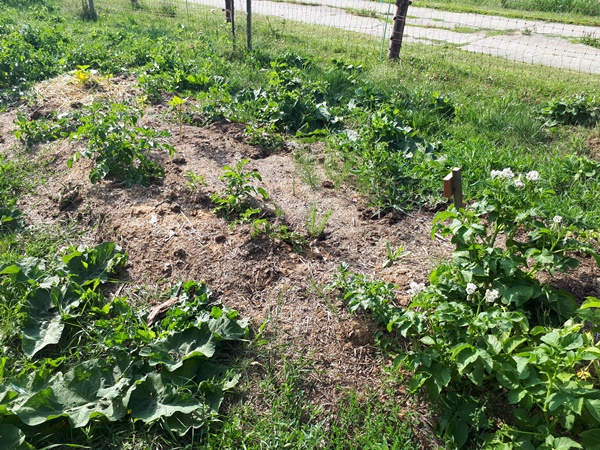
Well, after a while the first potato plants stuck up there heads (potatoes usually always grow). On some parts of the compost bed the potatoes grew better on some parts they did not thrive very well, but this was on both the rotary tilled and not rotary tilled part of the compost bed the same.
Potato plants in tilled compost bedPotato plants in no-tilled compost bed
As spring progressed I planted some corn (a popcorn variety), 2 pumpkins and some amaranth in between the 2 rows of potatoes. In the spring, when all the plants are still so small, I always think “o, there is enough space. I can plant some more”. Well the potatoes hat been more then enough, but it was interested to see how the other crops did.
The pumpkins for instance, I planted one in the tilled part and one in the not tilled part. At least these plants gave me a good noticeable difference. The pumpkin in the not tilled bed did not thrive and eventually died. The pumpkin in the tilled bed did not thrive very well, but somehow lived and grew a little.
Pumpkin planted in between potato plants not thriving in a no-tilled compost bedPumpkin plant flowering in a tilled compost bed
It was at this point we started to realize that we made a big mistake while building this compost bed. The compost bed is made out of straw, hay and sawdust. Straw and hay are “empty”. There is not much energy in this material, since the plant directed all of the energy into the seeds. So the soil developing from these components can never have much nitrogen. We need to at manure. The component we simply did not have until this spring when we got ourselves some chickens. After cleaning the chicken coop I simply divide the manure around the pumpkin plant, the one in the tilled part that still lived. Well, it helped, but the pumpkin still did not really thrive. I imagine, the soil just wasn’t really ready to use quite yet.
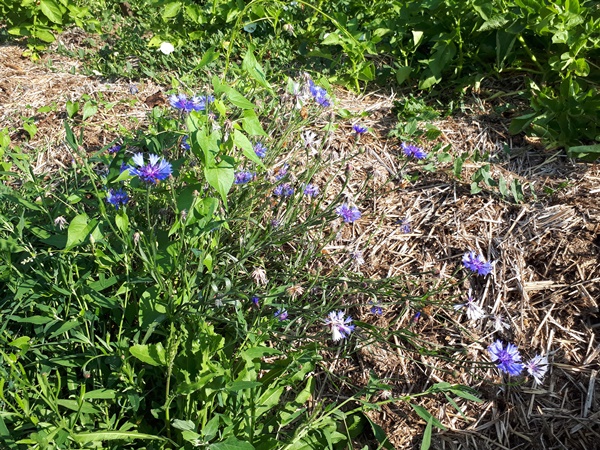
As the season progressed the potato plants mostly did well and grew nice and big as did the weeds. I found an occasional cornflower.
Cornflowers
The thistles are well spread out, luckily mostly around the edges of the compost bed and the bindweed is just taking over the complete compost bed. It literally is everywhere. The flowers are beautiful and the insects love them. I simply let go of the thought of weeding. I would not know where to start and I just do not have the time.
Bindweed all over the potato bed
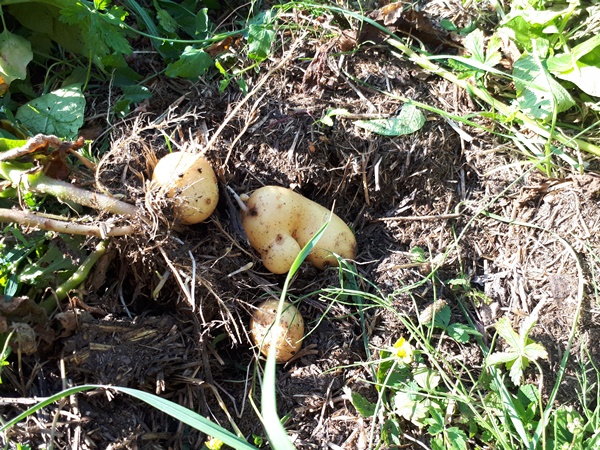
Then we got some runner ducks and put them on the pasture which includes this compost bed. The runner ducks are small enough, eat slugs and find hiding underneath the potato plants and the thistles (we have the type of thistle with big broad leaves). They where no problem at all, but then came the geese and destroyed the potato plants. I am glad the potatoes where already blooming at this point, so there would not be much growth anymore anyway. We started to harvest some potatoes here and there, because I wanted to compare both sides of the compost bed. At the tilled side we got a lot of smaller potatoes from one plant and on the not tilled side we got a few big potatoes from one plant.
Cleared potatoes in a tilled compost bedCleared potatoes in a no-tilled compost bedRed potatoes from tilled compost bed, yellow potatoes from no-tilled compost bed
Obviously the potatoes are different varieties, so I do not think we can really conclude anything out of this experiment. What I noticed is that the soil in the tilled part was much more broken down, darker, nicer and looser than the soil in the not tilled part, which was to be expected. The potatoes in the tilled part grew in and underneath the compost layer we had build up. The potatoes in the not tilled part grew underneath the compost layer we had build up. So this was like growing potatoes under mulch, but that I had a hard time digging the potatoes up from underneath the compacted compost layer.
All in all I had a nice potato harvest with nice big potatoes and a lot of small potatoes that will be saved as seed potatoes for next year.
As far as the corn went, just a little higher as the potato plants, bearably surviving. The geese then overran them.
A few corn plants in between potato plants
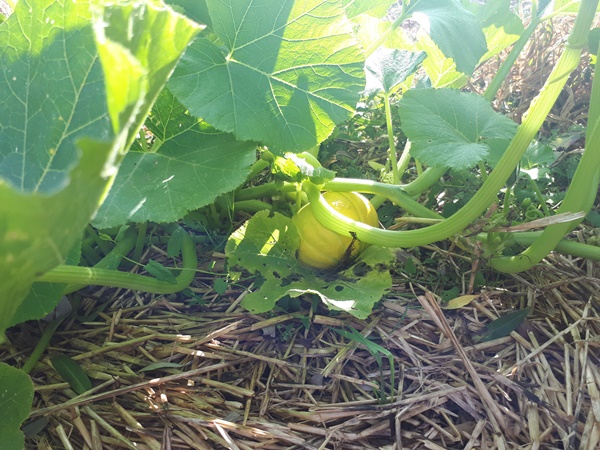
After I harvested all of the potatoes I dough out the one surviving pumpkin and planted it in another garden bed. The pumpkin liked it much better here. After a short time of setting it was thriving and it even set on some fruit. We will see if it ripens on time before the frost comes.
Pumpkin plant in a set no-dig bed with a pumpkin forming
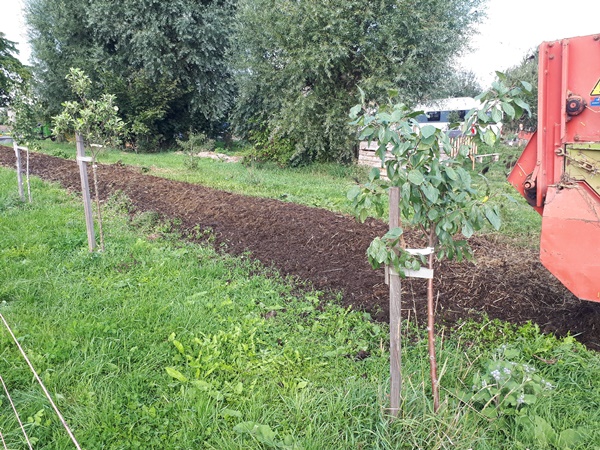
After the compost bed was cleared of all edibles and plants I wanted to keep my husband brought out a manure spreader full of fresh cow manure from our farming friend. This gave a thick layer of manure over the entire compost bed, which we then tilled in with our rotary tiller. I am not sure yet what I will plant in here next year, but there will be more then enough nitrogen in this compost bed next season.
Compost bed, black in colour from freshly spread cow manure
As a finishing touch I sowed a mix of green manure and covered the entire compost bed with straw. Only I waited to long after tilling the compost bed with doing so. The compost bed was full of weeds again already. O well, we will rotary till this bed in spring before we want to use it again. I will probably never get rid of the weeds here, but that’s fine. Weeds aren’t necessarily bad.
A partially straw covered compost bed with weeds
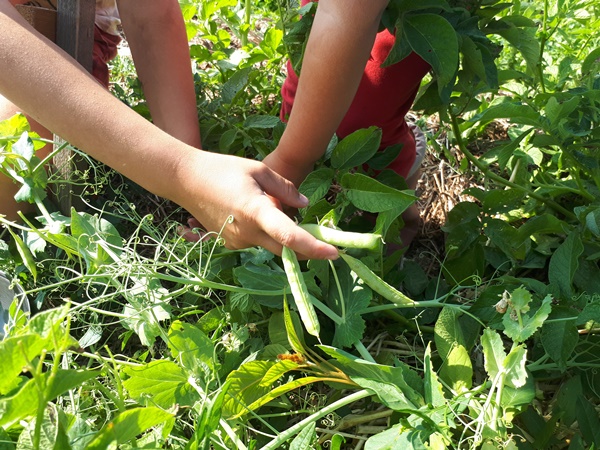
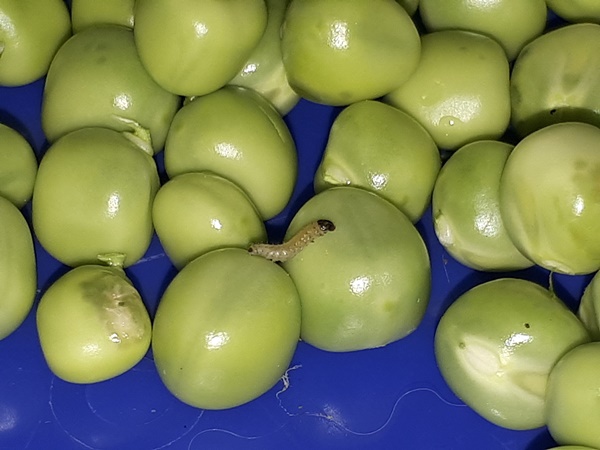
And we accidently grew a meal of peas in the tilled part. Peas from the chickenfeed we threw out. The pea plants partially did well and partially turned yellow. Some of the peas had worms in them, but the good once tasted well and the kid’s had a lot of fun peeling the peas.
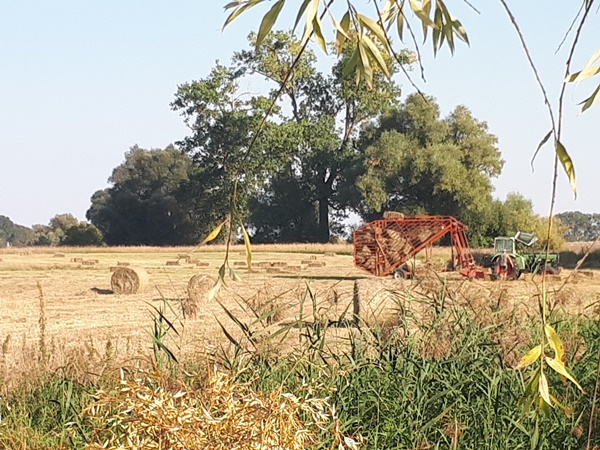
With the sheep and hare came the need for hay as winter feed. We have had sheep and hare before and made hay before, so we already have a baler. As a new addition, to make life a lot easier for us, we have a bale collecting trailer now and we are so happy we got this. It made collecting the hay bales from the field from something physical demanding to an easy one-man job.
Hay bales being collected from the pasture with a bale collecting trailer
We are lucky to be able to use a pasture nearby. This pasture is too small for the farmer to use with his big machines, so we can use it for free. We do need to bring it back into shape again, though. There has nothing been done this season and partly the reed grass and thistles had grown higher as the tractor is. The advantage is that everything has sown itself and there are no seeds left on the stalk. This makes it very interesting as biomass for the garden.
Normally the first half of September is a little late for making hay, but (in this case) we are lucky with another heat wave and where able to make good hay on some parts of this pasture and on other parts we made biomass for the garden.
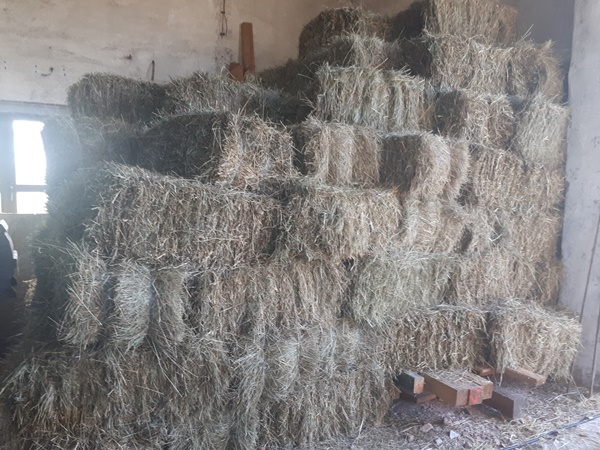
Stacked hay bales in a barn as winter feed for sheep and hare
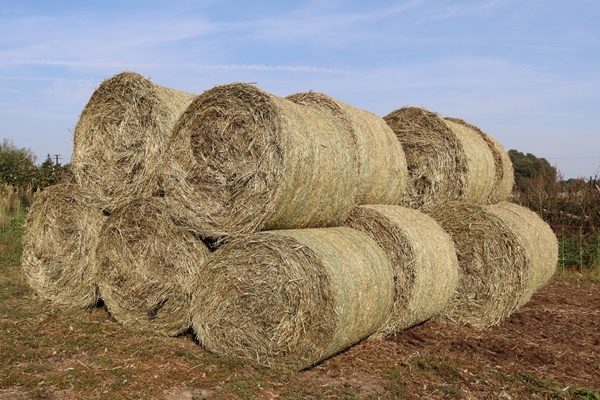
The good hay was pressed in small square bales for easy handling as animal feed and the biomass was pressed into round bales using the blades in the baler to cut the material smaller for easier use in the garden. Mainly the biomass is meant for mulching the garden beds. Without any seed pressure this is ideal. The straw I was using until now is still full of grain seed and I have grain growing everywhere, which is a bit annoying.
Stacked biomass round bales sitting outside
We did also have the change to make straw again early August, since that is needed as stable filling. The straw wasn’t very nice this year due to the strange and wet wetter this summer, but we are happy we where able to make any at all.
Stacked straw bales in a barn
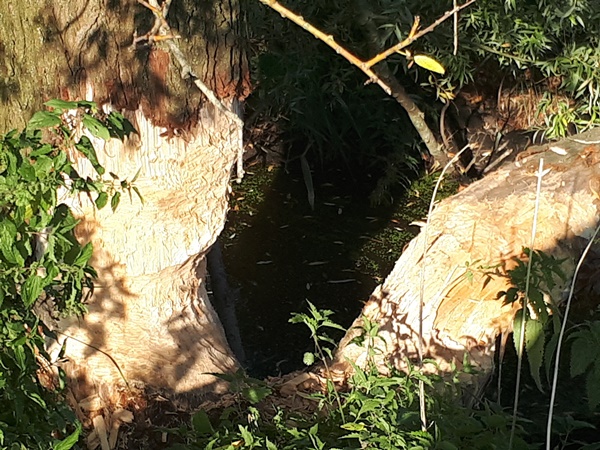
On the pasture where we made hay, there is a small water stream running trough the pasture with some big willow trees. We found massive damage from the beaver nagging on a big tree.
Beaver damage on a big willow tree
It is impressive to see how big the woodchips are this beaver produces.














 Beautiful Chaos