My new DIY greenhouse

How we build an inexpensive 4×6 meters greenhouse

Last fall we took down the greenhouse roof we hat made in the garden. Since it only was a roof, the wind blew trough it and the cold night air could come in, so it did not bring much advantage for pre-cultivating and extending the season. The foil on top was damaged also, so we decided to take it down. Our growing season goes from May to a little in October (when we are lucky), so a real greenhouse for pre-cultivation followed by a tomato and pepper crop is necessary to bring a useful yield in our region. Last year we lost our tomato plants early to blight and the peppers did not do anything at all. Only the chili peppers did ok, but most stayed green and we do like the peppers to ripen and turn red.

The metal frame

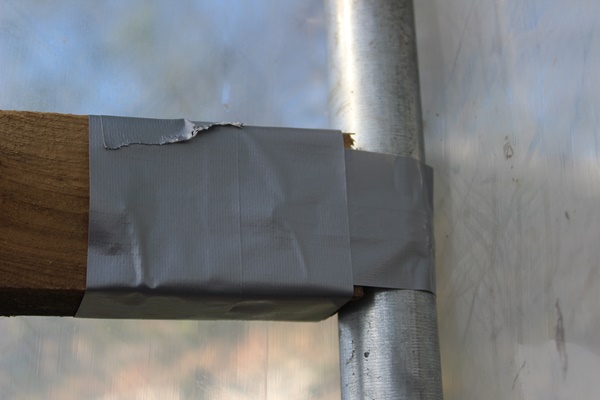
Last year the play tent of our children was damaged by a storm. The cover was torn and we trough that away. Some of the metal tubes where bend and snapped. We where able to fix these by putting a peace of wood in the tube and push the metal against each other. Obviously that leaves very sharp edges where we put some duct tape around.
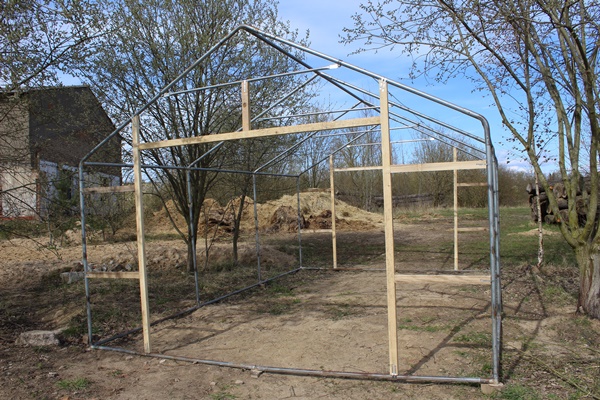
Metal tent frame with wooden doorframes for a DIY greenhouse

After putting the metal frame together we made a wooden frame in the front and back for doors. We secured the battens with perforated metal strips around the metal frame. Obviously this also gives sharp edges (dangerous for the foil) and we also taped over these with duct tape.

Putting up the greenhouse foil

We bought a tear resistant greenhouse foil with 0.19mm thickness. The foil is nice and firm and we hat no problems handling it in means of, the foil did not tear. First we cut off the length we needed and rolled the greenhouse foil back up. To get the greenhouse foil over the frame, we did get some one to help us and of course the kid’s helped also. It is nice that we have a work platform for the front end loader of our tractor. This made getting the greenhouse foil over the roof a lot easier and safer. A big piece of foil like that is hard to handle, but somehow we managed to get the greenhouse foil over the frame. The wind made it a bit difficult, but we always have wind here, so it made no sense to wait for a better day to do this. With the kid’s helping to hold the greenhouse foil down we managed to pull the foil in place and staple it to the wooden doorframe. Above the doorframe we folded the greenhouse foil and also stabled it down. In the corners of the doorframe we hat to cut off some of the foil, folded it and also stabled it down.

To secure the greenhouse foil to the metal frame around the bottom I had purchased some metal clips. These clips are a little bit bigger as the metal tubes of the frame. To protect the foil for the metal clips we put some fabric in between and the clips worked wonderful. They snapped on and the foil stays where it is.

Metal clip to secure greenhouse foil to the metal tube of the frame with a rag between clip and foil

We folded the foil underneath the frame to the inside.
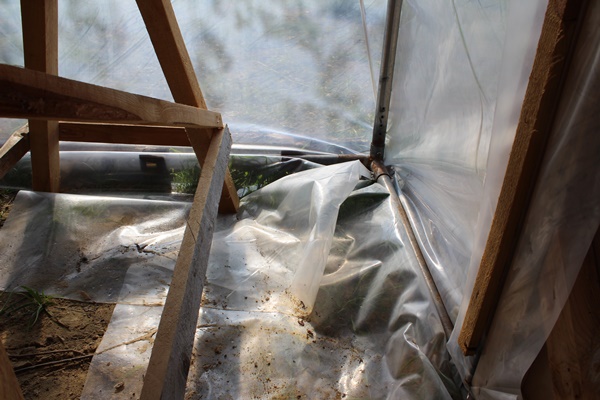
Greenhouse foil folded to the inside of the greenhouse

To hold the foil down when there is wind we also put some rope over cross over each segment of the fame, attaching the rope to a shackle and the shackle to a hole in the feet of the metal frame. Obviously we had to puncture the foil here, but I don’t think that will be a problem.

Putting up doors on the greenhouse

The battens we attached the foil to seem a bit small to attach such large doors to, so we upgraded the wooden frame, while securing the foil even more. We used boards to reinforce the doorframes, which my husband gave a nice decorative touch.

DIY Greenhouse out of a metal frame, with a wooden doorframe, covered with foil

The doors are kept simple, with a rectangle frame out of battens with one cross batten and bracings in each corner. Then covered with foil, which we also stabled down.

To close the doors we used what we had. Some wood bocks that can turn for the secondary door, a metal pin to push in the ground and a padlock bracket with a snap ring for the primary door.

DIY greenhouse finished, more or less

For now the greenhouse is finished and I can start using it, but before fall comes we will have to do something about the different openings the greenhouse has. There is a big slit above the doors we will have to do something about. Also the ground was not evenly, so there are several slits between the ground and the greenhouse as well. For now we put some logs before them, to keep the cats out of the greenhouse, but we will have to fill these with sand to keep the warmth in when it gets colder again.

At the moment I am just so happy we finally made a real greenhouse. The kid’s and I immediately started with pre-cultivating a lot of vegetables, herbs and flowers for the coming season.

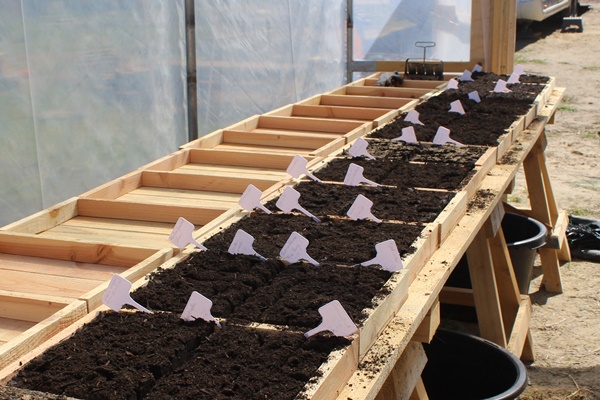
Even some lettuce has already sprouted.

Lettuce seedlings

During the day, when the sun is shining, the temperature rises up to 30°C and we open the doors to keep the heat down a little. At night the temperature still drops to about 2°C, so I am afraid to put my tomato and pepper plantlets in the greenhouse. I am worried that 2°C is to cold for them and I will kill the plantlets, so they will just stay in the caravan for now.

Tomato & pepper seedlings to densely sown in a tray on a table next to some Lego

Since I have rhizomes’ grass growing everywhere I am not making raised beds in the greenhouse, but I am going to plant my tomatoes & peppers in mortar tubs and wooden made planters, but more too that after I planted my tomatoes & peppers in my new DIY greenhouse.

Building a bathroom: Part 1: Putting up the basic structure

Since we are living in a caravan without a shower and, most of the year, it is to cold and windy to shower outside, we are going to build a bathroom inside our barn with a work shop on top.

Desirable was we could have build the house we had in mind, with a bathroom, but that dream has been swept off the table by the official authorities. We will wait a few years for curtain things to change and try to get an approval for building our house then.

But until then we need a few things set in place to make our daily life a bit nicer and easier, starting with a bathroom and a playroom for the kids/ sewing room for me. Obviously the last two will be one room.

This structure inside our barn will be insulated and we will be able to heat it. I am so very much looking forward to be able to use this room. Since we have sold our Tiny House I had to pack my fabrics and sewing machines into our storage. I am missing being able to sew clothing for my children and me.

Also the kitchen in the caravan is very small, too small for kitchen appliances to make life easier and make cooking more time efficient. I like to make my own yoghurt, I bake my own bread (the hand mixer is on/ over its limit with this), there is no place to put up my ferments (in the barn they turn bad), etc. I also want to make my own soap again and make our own cheese again. The pressure canning I did last fall was a bit unpleasant in the cold (almost freezing) and I had to put the hot jars in the caravan to let them cool down slowly, which took up a lot of space.

One other major thing that needs space is a freeze dryer. I really want to have a freeze dryer for preserving our harvest from the garden this year. So the room we are creating will hold my sewing supplies, my kitchen appliances and a freeze dryer which I hope to purchase this year. The room will not be very big, so we will have to see how we will get everything a usable spot, a working space and some room for the children to play, but more to that in a later blog post.

For this project it is very convenient that we have a lumberyard, since we did not plan ahead, but came to this idea only recently. The support frame is made out of beams and posts which where for a customer who changed his mind about the size of the lumber, so these have been sitting for a while already. That is great, since you should not build with freshly cut wood, but let lumber sit for a while first. The rafters and planking where also already sitting, meant for a different project.

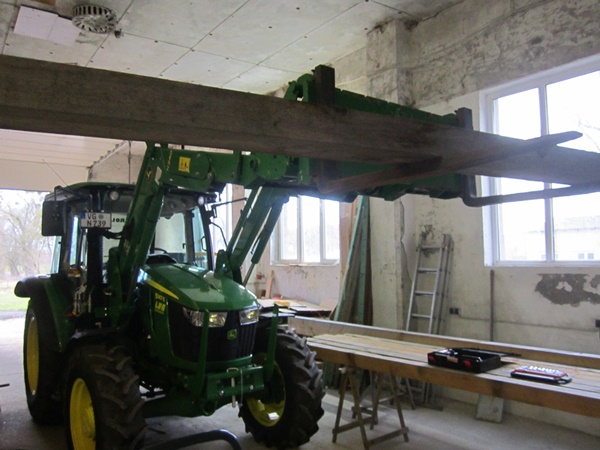
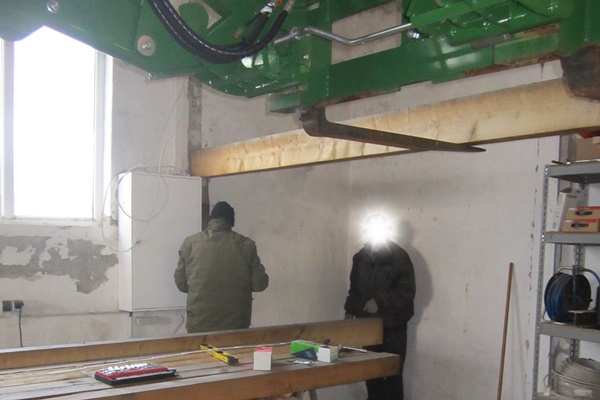
The building started with positioning the big beams with our tractor, they are too heavy to lift by hand.

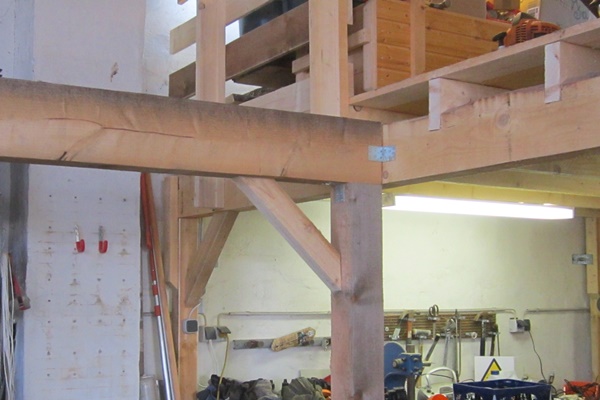
Then the posts are positioned and fixed underneath with metal angles.

To give the structure stability, bracings are put in place in the corners.

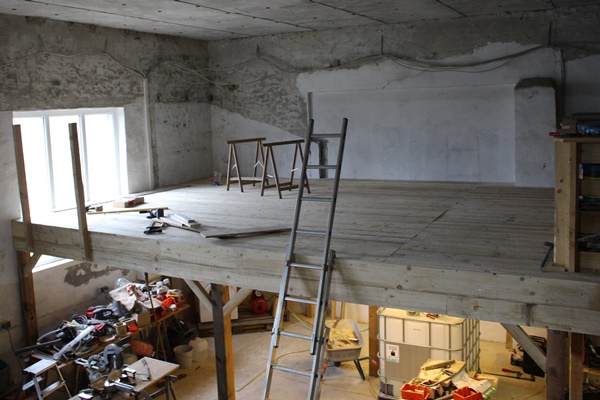
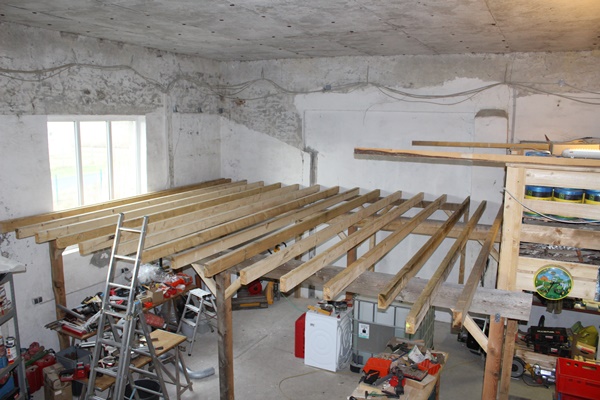
The deck is made with a lot of rafters and planking on top to close the surface.

Some lights are put in place underneath the deck.

To make the deck safe to use, a railing is attached and of course a stairs is made. For the safety of our children a gate is made on top of the stairs and in the middle of the railing a gate is made, so we can put things up on the deck with the tractor.

Now the first stage is done and my husband needs to set up his workshop again. Smaller tools and all of the supplies will go on the deck and the bigger machines will find there place on ground level. Next thing to do is framing of the walls, but that is for another time.

Building in an underground cistern without digging a hole

We are not hooked up to the sewer and need a solution for our waist water. We are in a water protection zone and have been asked not to dig any holes deeper then 50 cm into the ground. We have not found any cistern with qualification for above ground, so we some how have to build in an underground cistern above ground.

We decided to sacrifice the corner in our barn directly beside the big door, so the cistern would be protected from the sun and easily accessible for emptying.

An underground cistern, obviously, is made to go under the ground. This means the cistern gets pressure from outside to withstand the pressure from the inside when it is full. If this pressure on the outside is not there, the cistern could get damaged. So we came up with the following way to build in this cistern above ground.

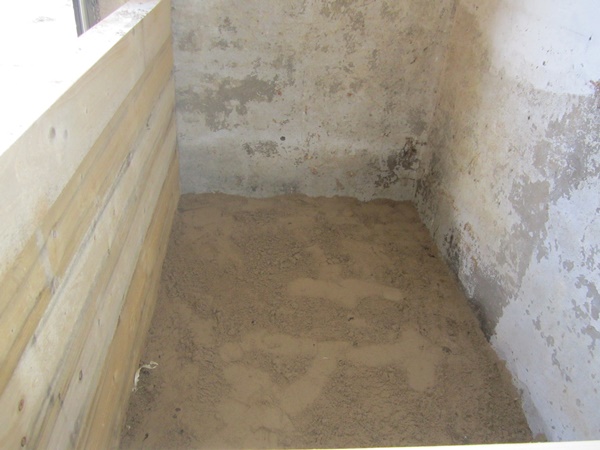
We started by building a wooden construction coming out of the corner about 20 cm bigger as the cistern is.

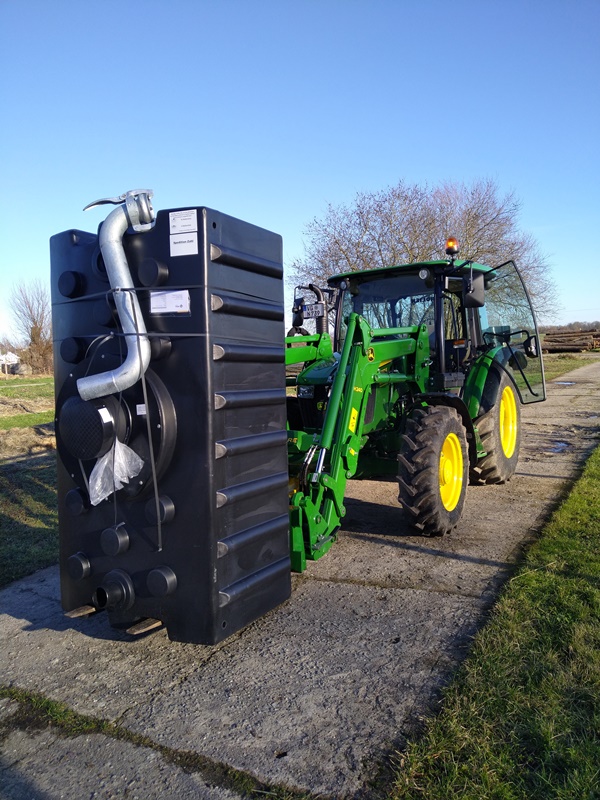
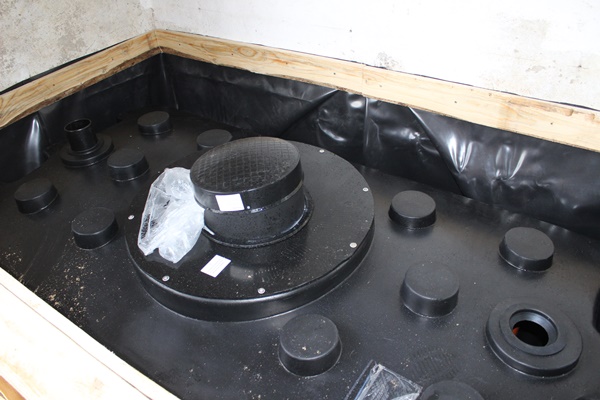
This is the cistern we bought.

We put in a thin layer of sand on the bottom to protect the pond liner, which is coming in next, against any sharp spots in the concrete floor.

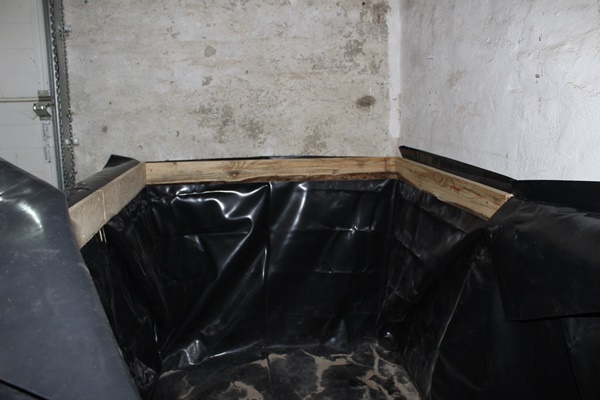
We have laid out the entire basin with the pond liner, just incase there would be a problem with the cistern, the waist water will be contained and not flood our barn.

This would also have made for a nice pool.

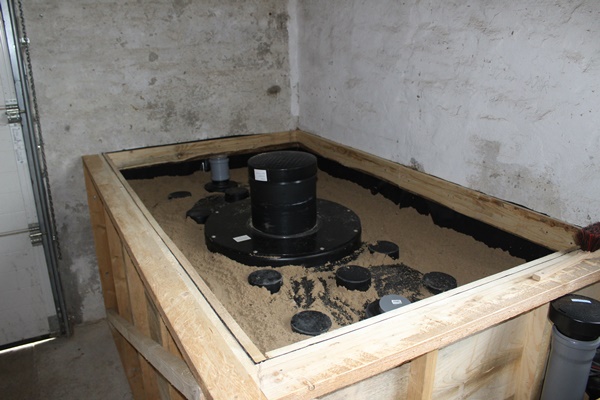
After another layer of sand the cistern is put in place.

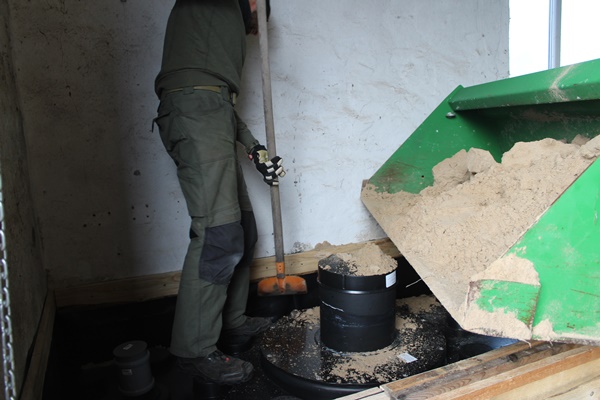
Around the sides is also filled with sand which we compacted.

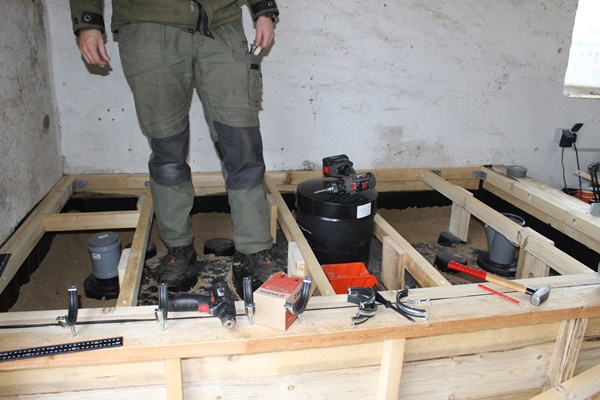
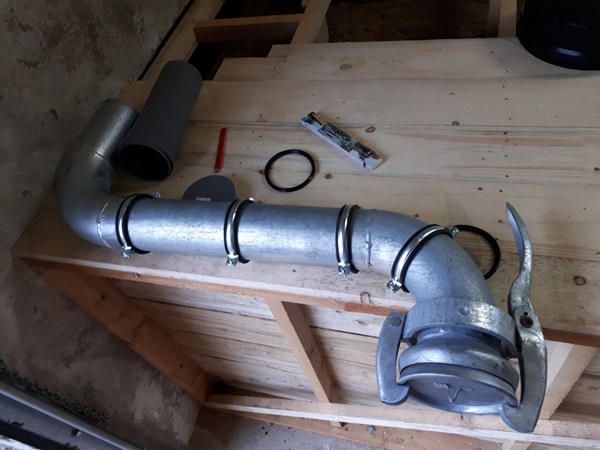
Then we build a deck on top, so we can stand on it to empty our toilet waist in the cistern. The pipe going up is for venting. It has a filter on top, so it won’t smell bad in our barn. The metal pipe is for draining the cistern. The big black lid in the middle is where we can fill in our waist water. The hole in the deck is where we will connect the outlets of the toilet and the shower we are going to build in into our barn this year. Obviously that would not work by gravity, so we will put a waist water shredder pump in between, but that will be a future project.